From everyday market stalls to chef-driven kitchens, Oaxaca’s culinary scene remains profoundly local. Cooking here in Mexico’s richest food destination is rooted in centuries of Indigenous tradition and ingredients found right here. It’s a place that rewards travelers who follow their appetite as faithfully as their curiosity. For me, that curiosity has often found its best guide on foot, walking the streets with Culinary Backstreets.
The company’s Earth, Corn, and Fire tour may be billed as a food tour, but it unfolds as something far more immersive: eating as cultural observation, tasting how history, ritual, and identity are preserved at the table.

Cheesy, Corny, Captivating
Our Oaxacan experience begins outside the Mercado de la Merced, where we meet our guide, Pablo, for a brief primer on what lies ahead. Moments later, we’re seated inside, greeted not with menus but with a bubbling bowl of Oaxaca cheese melting into a tomato-rich broth, accompanied by a tamale unwrapped from its warm corn husk. It’s been stuffed with a black-bean filling, fragrant with spice. This humble and traditional start tunes the palate for everything that follows.
Before spilling back into the street, we take a brief detour through the market, allowing Pablo to make a seemingly unremarkable purchase of a handful of hoja santa leaves and a small bag of roasted corn kernels. Their purpose isn’t explained, but in Oaxaca, ingredients like these rarely travel without intenticon.
The mystery continues at a corner molino shop whose singular purpose is grinding a mix of ingredients into mole and herb pastes. In a matter of seconds, Pablo’s roasted corn kernels are ground and transformed into a warm dough and just as mysteriously, slipped into a plastic bag with no commentary, no reveal.

Walking through the neighborhood of Jalatlaco feels like roaming through an open-air gallery. Colorful murals and street art spill across weathered facades as locals pass by. We duck into an unassuming café where Pablo leads our small group straight into the kitchen, finally lifting the curtain on our mystery ingredients.
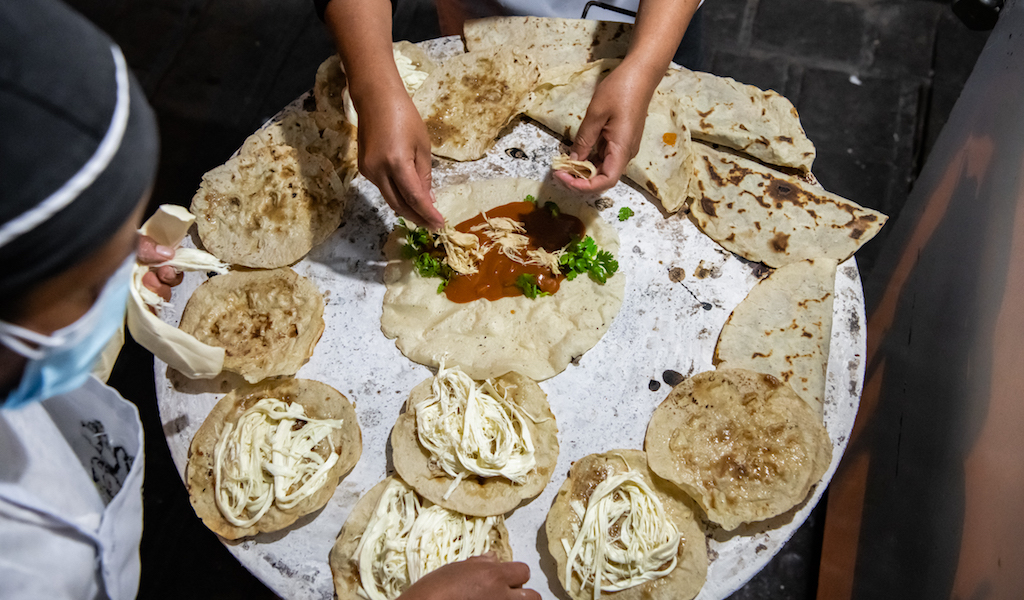
The warm corn dough is pressed and warmed into fresh tortillas and the hoja santa leaf is folded around a cracked egg, sizzling briefly on a hot griddle. Wrapped together, they emerge as a deceptively delicious egg sandwich entirely worth the suspense.
As late morning drifts toward midday, we slip into a hidden farmers’ market, where organic ingredients become a spread of foods, fresh juices, and traditional drinks. A clay pitcher of tejate (an ancestral blend of cacao, corn, and toasted mamey seeds) is poured cool and frothy into a dried, hand-painted jícara shell. Its earthy flavors demonstrate cacao’s quiet presence in Oaxacan life.
That introduction deepens at a nearby chocolatier, where indulgent sampling accompanies a lesson in centuries-old cacao traditions. As we savor the spiced richness of Oaxaca’s chocolates, it becomes clear that cacao here is far more than a sweet. It’s part of the regional identity.
Holy Mole!
The lesson comes full circle at a lunchtime table presentation of three distinct moles, each dark, aromatic, and patiently layered, each revealing cacao in its most iconic form: a sauce that defines Oaxaca’s most culinary legacy.
Mole negro arrives first, dark, glossy, and deeply layered, its cacao lending bitterness and depth rather than sweetness. Coloradito follows, warmer and brighter, balancing chiles and spice with subtle richness. The day’s special entree of a peanut mole is lighter in hue yet no less complex.
Mole is not a single recipe but a living language. With every bite, Oaxaca’s flavor unfolds.
To love Oaxaca is to appreciate food as heritage rather than trend. There is no better way to experience its flavors and the traditions behind them.