As our guide, Darren Capewell, maneuvers the Land Cruiser along a sandy white beach in Francois Peron National Park, we pass a tidal flat filled with mangroves and tall grasses. Out of nowhere, pint-sized euro kangaroos emerge from the greenery, leaping directly in front of the 4×4. Capewell, known to all as “Capes,” screeches to a halt. “Little rascals”, he says, before continuing cautiously. An entire mob of the grey-brown marsupials hops out in front of the car, bounding swiftly over the terra cotta sand dunes beyond.
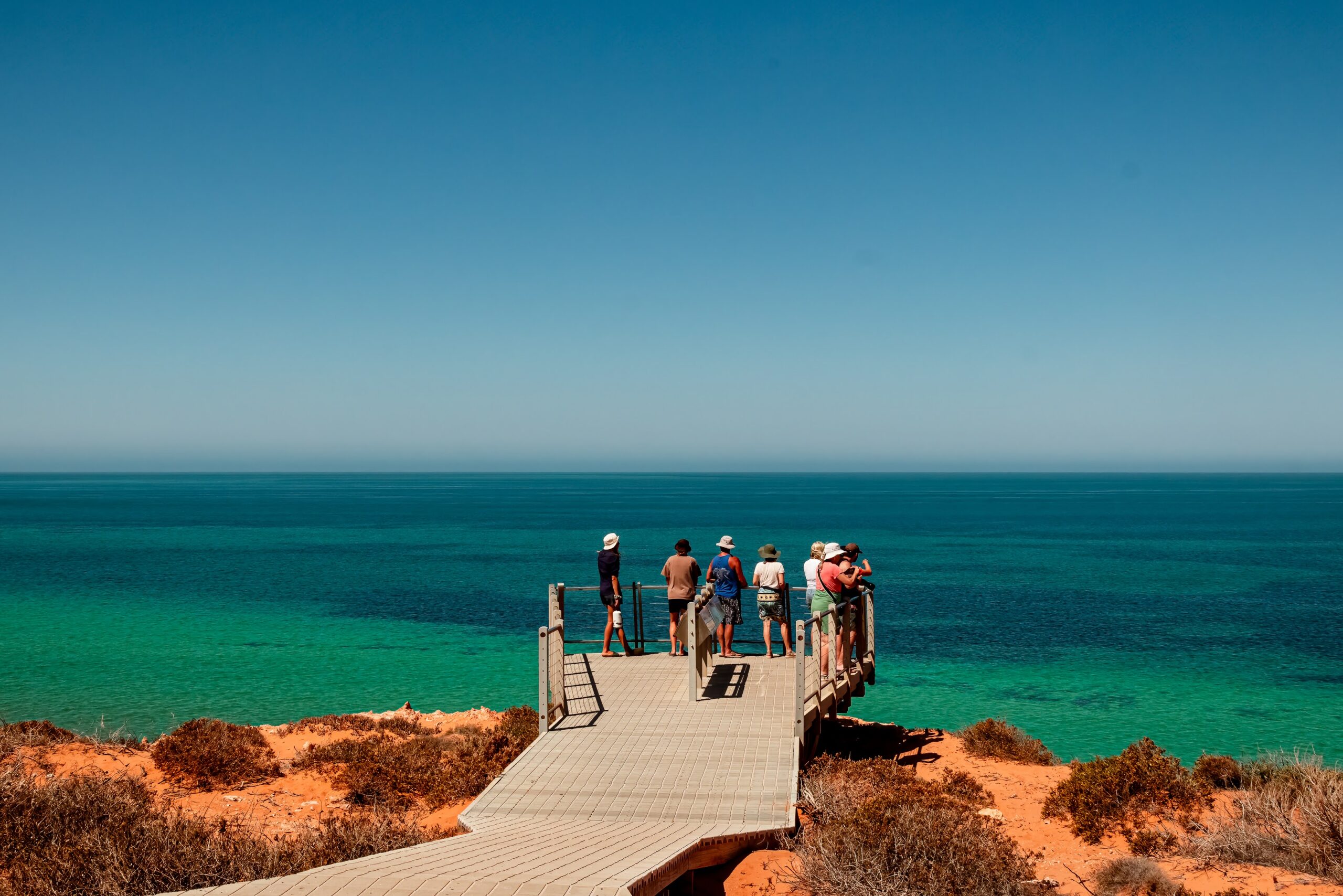
Situated along the Coral Coast of Western Australia, 850 kilometers (528 miles) north of Perth, the national park lies within the UNESCO-listed Shark Bay World Heritage Area. The area encompasses the 52,000-hectare (128,495-acre) national park, a former sheep station (translation: “ranch”) located on a narrow peninsula in Shark Bay, a second peninsula beside it to the west, the index finger–like Dirk Hartog Island (also a national park) directly above that, and the bay itself. Together, these form an otherworldly tableau of cayenne-red cliffs and acacia-speckled sand dunes set against Curaçao-blue waters. An ultra-biodiverse marine park, the bay teems with manta rays, sharks, dugongs, turtles, and dolphins, the water so clear you can easily see them swimming and foraging from the lookout platform perched atop Skipjack Point.
Hoping to photograph the euro kangaroos, I ask Capewell to stop the vehicle and I jump out. “The wallaroos are long gone, sister,” says Capewell. “With roos, you have to have your finger on the trigger before you even spot them.”
Driving away from the mangrove beach, we turn onto a burnt-orange sand road.
Paths of Communication
On the way to our next point of interest, Capes, a descendant of indigenous Malgana and Nhanda peoples, puts me into the picture. “Shark Bay is called Gutharraguda in Malgana” he says. “It means ‘Two Waters’. This the place where the red desert meets the Indian Ocean”, he says proudly. “Everything is connected here. This red sand comes from the desert, from the middle of Australia.” It’s a staggering thought. Australian writer Robyn Davidson, in 1977, trekked the 1700-mile distance from Alice Springs to Hamelin Pool, near Shark Bay, with four camels and her dog, a journey she recounted in her book Tracks.
As the owner of Wula Gura Nyinda Eco Cultural Adventures, Capes loves what he does for a living. It’s something he doesn’t view as a job.
“My job isn’t tourism,” he says. “My job is looking after Country, this place we call Gutharraguda.” The word “Country”, in the sense in which Indigenous peoples in Australia use it, is a complex, all-encompassing term referring to land, home, culture, creation, and more.
“Tourism is a vehicle that allows me to be on Country and to take care of it,” he continues. “It combines my two greatest loves, apart from my family: my love for the environment and my love for my culture. And it allows me to introduce people like you to it [Country]. To learn how Country can talk, so you get to feel it rather than just see it.”
As we near our destination, Capes abruptly pulls over. Springing out of the 4×4, he runs over to my side, where he approaches a tallish bush just outside my window. He begins to sing in his native language as he picks off a flower bud that resembles a yellowish-green broccoli floret. Depositing it in my hand, he orders me to smell it. It hasn’t flowered yet, but it has a mild, honey-like scent. “Summer-scented wattle,” he declares.
Endemic to Western Australia, the Acacia rostellifera lends coastal dunes a lovely fragrance during the warm summer months. It’s also a fire-resistant plant that regenerates by way of underground root suckers after seasonal fires. Historically, it provided First Nations with ecological stability as well as shelter and fuel.
Capes sings often during our tour. “Our language is a song; you sing it.” He sings to.…
EXCERPT ONLY. CLICK TO READ THE FULL ARTICLE.
This is an excerpt from the latest issue of Porthole Cruise and Travel Magazine. To continue reading, click above for a digital or print subscription.