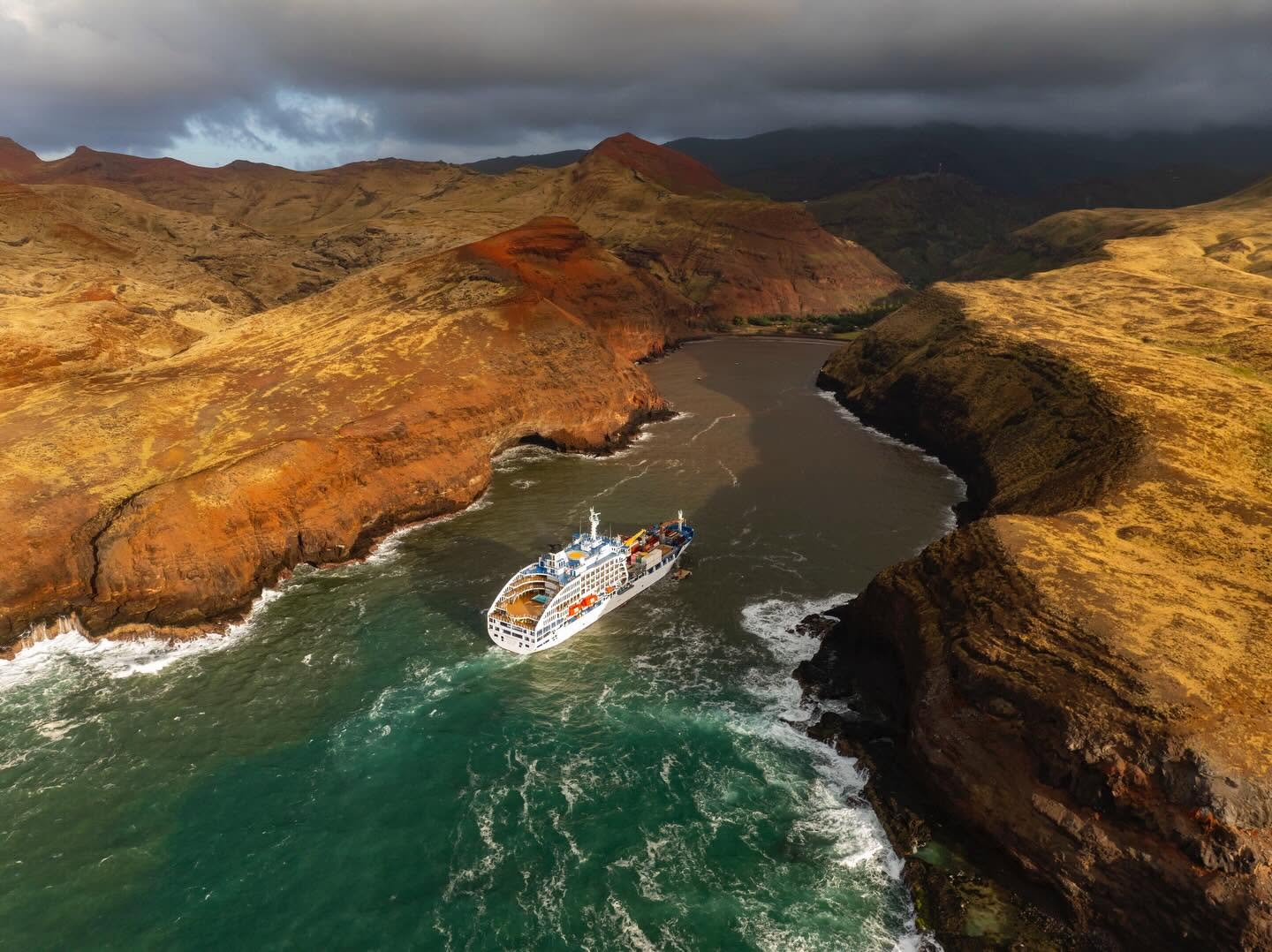
Three hundred miles out to sea, the only sound beyond my balcony is an ocean which, in this precise location, is 3 miles deep. MV Aranui 5 departed Rangiroa Atoll yesterday, and Tahiti the day before. Since then, we’ve steadily sailed towards the equator and to a group of islands filled with myths and mountains. They are the Marquesas Islands and the ship I’m on is most unusual, yet perfectly suited for this journey.
A Different Ship
Aboard Aranui 5 are about 200 other passengers, plus some mailbags, provisions, and building materials. The rear half of this 10-deck ship has the appearance of a small cruise liner, complete with outdoor pool, main restaurant, and a few bars. The front half is filled with cargo that helps sustain life in the Marquesas Islands, with two cranes completing the practical look of the multi-purpose vessel.
Aranui 5’s busy cargo operations end up being a surprise distraction when reaching our first stop in the Marquesas, but only until we’re allowed to disembark and begin our day on Nuku Hiva. One of the first sights I see is a giant tiki (which are statues or carvings representing ancestors) staring out to sea. It’s 40 feet high and is a guardian of tradition and knowledge, making it an appropriate welcome to these culturally rich islands.
On the other end of a dramatic drive through Nuku Hiva’s mountains is Hatihe’u Bay, which sets a perfectly Polynesian scene of jagged volcanic peaks covered in lush forests above long, sandy beaches with bowing palms. Having reached here only 1,200 years ago, the Marquesas Islands were among the last to be settled by the Polynesians on their long migration across the Pacific.
Hatihe’u Bay is where the large Keikahanui clan once lived, before — it’s believed — a tsunami pushed them further up the mountainside. What became their home is now an archaeological site called Kamuihei, the most dramatic part of which is an immense 600-year-old banyan tree beside which priests once conducted ritual sacrifices and where, today, locals perform traditional dances.
“The tribal leader had two roles: first, to protect his people, and second, to feed them,” I was told by Pascal Hatuuku, Aranui 5’s guest lecturer and a Marquesan local. He had joined us today, along with the ship’s guides who helped us interpret petroglyphs chiseled into rocks centuries ago.
Living Islands
Excursions such as these are included in the cruise price, but sometimes the culture comes on board the ship in the form of yet more dancers, plus ukulele players (there’s so many ukulele players in French Polynesia). One optional excursion worth the extra cost was the 4×4 drive on the island of Ua Poa where basalt pillars tower up to 4,040 feet in the humid air.
When I mentioned that I was visiting the Marquesas Islands to locals in other parts of French Polynesia, I was told that this was a place with particularly strong mana, or spiritual force. On Ua Poa, that sense of mystery was enhanced by a legend describing….
EXCERPT ONLY. CLICK TO READ THE FULL ARTICLE.
This is an excerpt from the latest issue of Porthole Cruise and Travel Magazine. To continue reading, click above for a digital or print subscription.