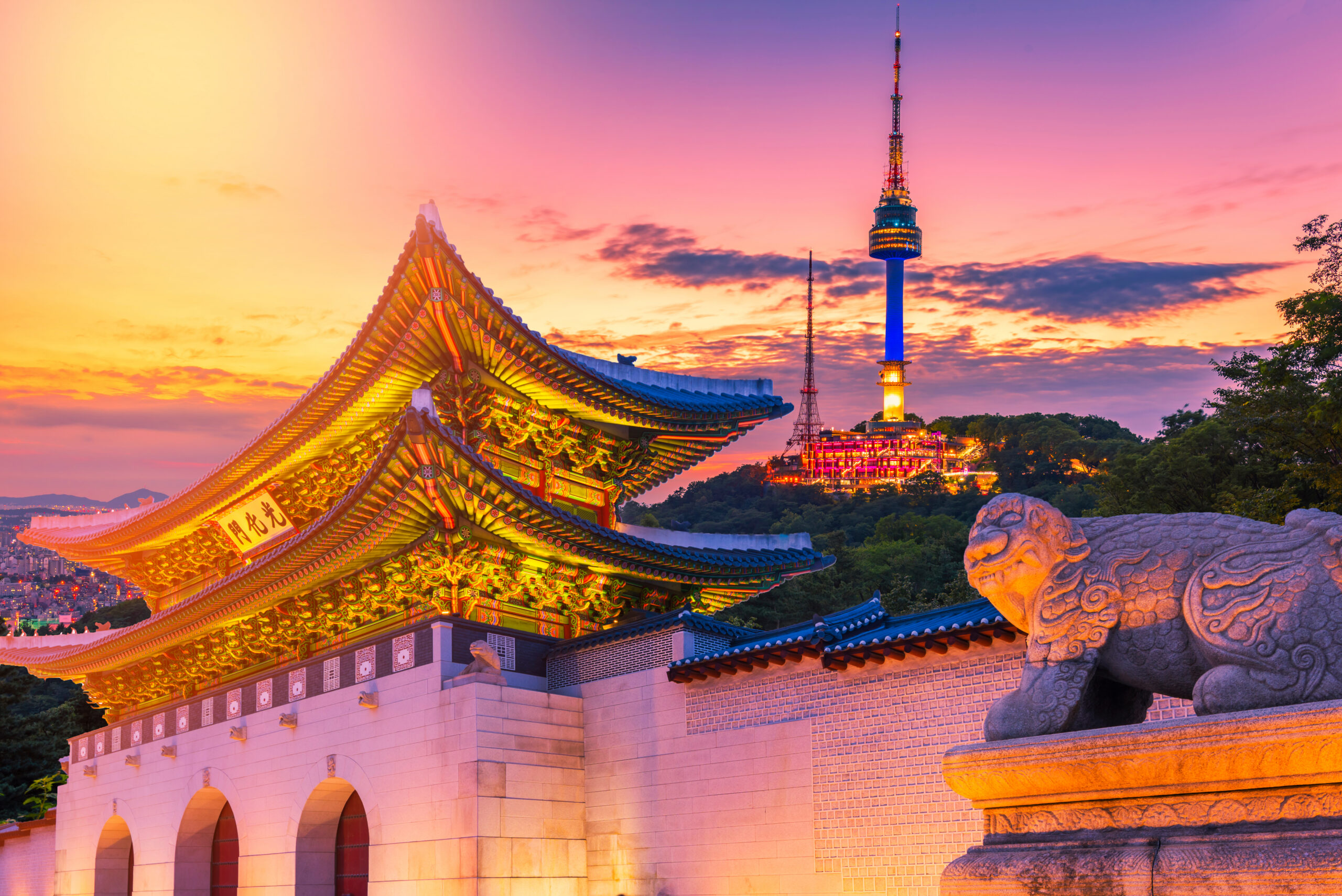
I’m admiring the beautiful carvings of the Gyeongbukgung Palace in Seoul while clad in the traditional Korean hanbok dress — a short jacket top and a long, full graceful skirt. “One more photo, please!” I plead with my husband Dennis, posing against yet another multicolored chiseled arch.
Around me, men and women, young and old, locals and tourists alike, are sporting similar attire — it’s both a ritual and a fashion statement to explore Seoul’s ancient royal palaces dressed in vintage outfits while snapping loads of selfies. “We Koreans have no problem being old-fashioned one minute and modern the next,” Michelle Hong, my guide from Intrepid Travel, tells me. “We love blending both.”
Just a few years ago, South Korea, nicknamed “Land of the Morning Calm,” may have been off the beaten path for Western travelers. But K-pop hits like “Gangnam Style,” bands like BTS, foods like kimchi, and the quadruple-Oscar-winning Parasite placed this country on the map. Whatever city you visit, the cultural kaleidoscope never ceases to surprise you.
Seoul
Stretching over 200 square miles and home to almost 10 million people, Seoul has been the country’s capital for more than 600 years — and it shows. Here, historic palaces hide among skyscrapers, traditional markets coexist with extravagant shopping malls, and old-fashioned teahouses elbow fancy coffee shops.
Adjacent to the Gyeongbukgung Palace lies the Bukchon Hanok Village, (hanok means “traditional home”) where residents still live in houses built over 500 years ago. Over time, plumbing and electricity arrived, but the distinct clay-tiled roofs and carved wooden doors remained. Many homes still use a traditional heating system called ondol, which translates as “warm stones.” Laid underneath the floor, an ondol system consists of stone channels that direct and trap the hot air from the kitchen fireplace underneath the rooms, keeping the house warm all night long.
Later, when we head to Gwangjang, a 120-year-old traditional market that sells everything from spices to clothes to medicinal herbs, we walk along Cheonggyecheon, a 6-mile-long urban stream hugged by trees and plants, with fish lurking inside it. A masterpiece of modern engineering, Cheonggyecheon was rebuilt from a decommissioned highway to.…
By Arundhati Hazra
EXCERPT ONLY. CLICK TO READ THE FULL ARTICLE.
This is an excerpt from the latest issue of Porthole Cruise and Travel Magazine. To continue reading, click above for a digital or print subscription.