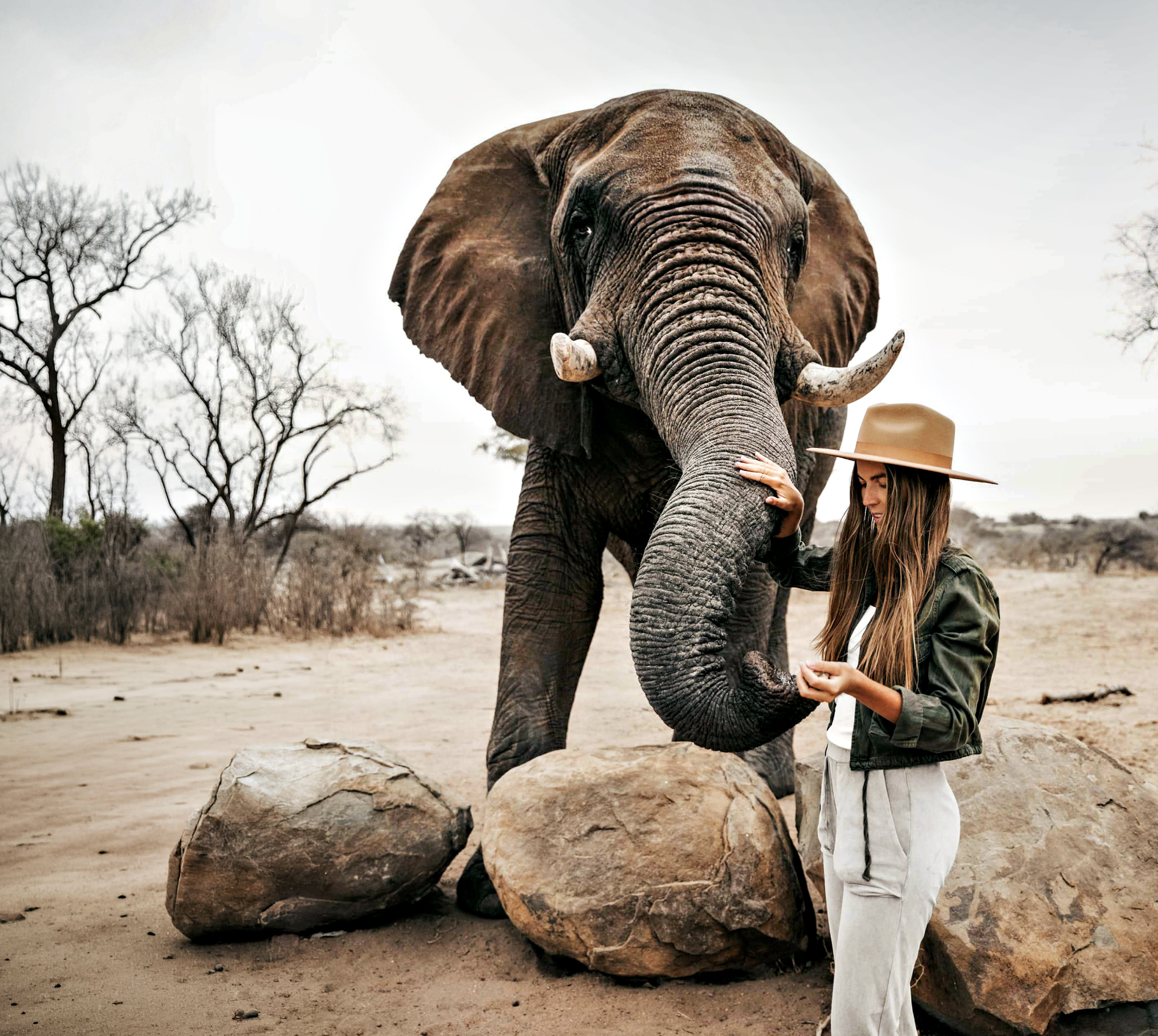
There is a collective holding of breath as the elephants begin arriving.
Nathan, my personal safari guide from Jabulani Safari, had driven us to a waterhole on Kapama Private Game Reserve, located outside the South African town of Hoedspruit. A long table was laden with appetizers and pretty cakes and a couple of bartenders prepared classic sundowner drinks for the lodge guests. A dozen or so directors’ chairs sat in a semicircle facing the waterhole. The excitement in the air was like the buzz on the red carpet on Oscar night as more guests arrived and we waited together for “the big moment”. As we chatted, the honey-gold light of early evening faded, the sky turning blood orange before softening to sorbet pink and lavender purple.
Then we see them on the opposite side of the waterhole. The Jabulani herd, currently 15 strong, amble by, single file, each with their carer at their side. The pachyderms are on their way to their stables to tuck in for the night after a day out foraging on the 16,000-hectare (39,536-acre) reserve. Before continuing to their open stalls, several pause to take one last drink, their trunks hoovering up gallons of water and spraying it into their mouths.
Near the end of the queue comes Khanyisa. At 5 years old, this albino elephant is the youngest member of the herd. She suffered traumatic injuries as a baby as a result of losing her mother and getting caught in a snare. But she seems to have recovered well as she pauses for a drink.
Rooted in Earth
A growing number of African safari lodges are involved in wildlife conservation efforts, but since its beginnings conservation has always been Jabulani’s raison d’être. The sophisticated, two-Michelin-key property consists of a classically designed main lodge, dining room, and bar; two villas; six timeless, ultra-private suites; and a spa. Relais & Châteaux opened the lodge in 2005 to help support and protect a refugee elephant herd from Zimbabwe and care for orphaned baby elephants — in addition to contributing more generally to wildlife conservation.
The story began in 1997, when Jabulani Safari owner and managing director Adine Roode, whose family owns Kapama, had taken in and rehabilitated an orphaned baby elephant who was christened Jabulani. Later, in 2002, having agreed to provide a home to the then-homeless Zimbabwe herd, she founded Hoedspruit Elephant Rehabilitation and Development, or HERD, which currently employs a staff of 140. In 2019, HERD built the only elephant orphanage in South Africa.
Roode’s is a dedication to the welfare of animals rarely matched. Not only does she oversee operations both at the lodge and at HERD, she has fought in the trenches with injured and traumatized orphaned elephants.
“It was really tough with Kanyisa,” Roode says. “When she arrived, she had a snare that went through her mouth. There were two cables that were knotted and went back through again, cutting off part of her ear. I had to clean the wounds daily, but I think she knew it was for her own good.”
The heartbreak of losing her mother, together with the pain in her mouth, were so extreme that Khanyisa began to refuse her milk bottle. Luckily, Roode worked out a way to give the orphan her bottle, but Khanyisa’s health took a frightening downturn nonetheless. “There were a few nights where I really believed I was losing Khanyisa,” says Roode. “One night I could feel death knocking at the door. We were lying together, and I just prayed.”
Wild Encounters
Guests at Jabulani Safari, where every suite and villa comes with its own butler and safari guide and every guest is treated like both a friend and an A-lister, can observe Khanyisa and the rest of the herd from.…
By Elizabeth Warkentin
EXCERPT ONLY. CLICK TO READ THE FULL ARTICLE.
This is an excerpt from the latest issue of Porthole Cruise and Travel Magazine. To continue reading, click above for a digital or print subscription.