Countless journeys on ferries, I knew full well, counted for zilch when speculating about my first cruise and what it might be like. Preconceptions, both positive and negative, created uncertainty … but overriding my wariness was the geographical uniqueness of the destination — the Peruvian Amazon — and the possibility that encountering its primordial environment would be a life-enhancing event. That was the wager.
The Amazon River’s origin lies in southwest Peru but it is only in the northwest of the country, at the confluence of the Amazon’s two headstreams, the Ucayali and Maranon rivers, that the Amazon River officially starts to bear its name. If the length of either of the headstreams is factored in, the Amazon becomes longer than the Nile; regardless, the Amazon’s discharge of a higher volume of water than any other river in the world makes its mightiness indisputable. Adding to an equation that holds out the promise of a river cruise in this location being a colossal experience is the fact that the Amazon Basin is home to one in 10 of all species of wildlife in the world.
A Jungle Departure
The logistics for the cruise with Aqua Expeditions are not daunting: a 2-hour flight from the country’s capital, Lima, brings you to the riverside town of Iquitos and then a short drive to the jetty and embarkation on Aqua Nera. Iquitos, only accessible by air or river, has the feel of an authentic frontier settlement. Cars are a rarity; motorbikes adapted to carry passengers resemble tuk tuks; market stalls spill over the streets, busily retailing life’s essentials: chainsaws, machetes, fishing tackle, and smart phones.
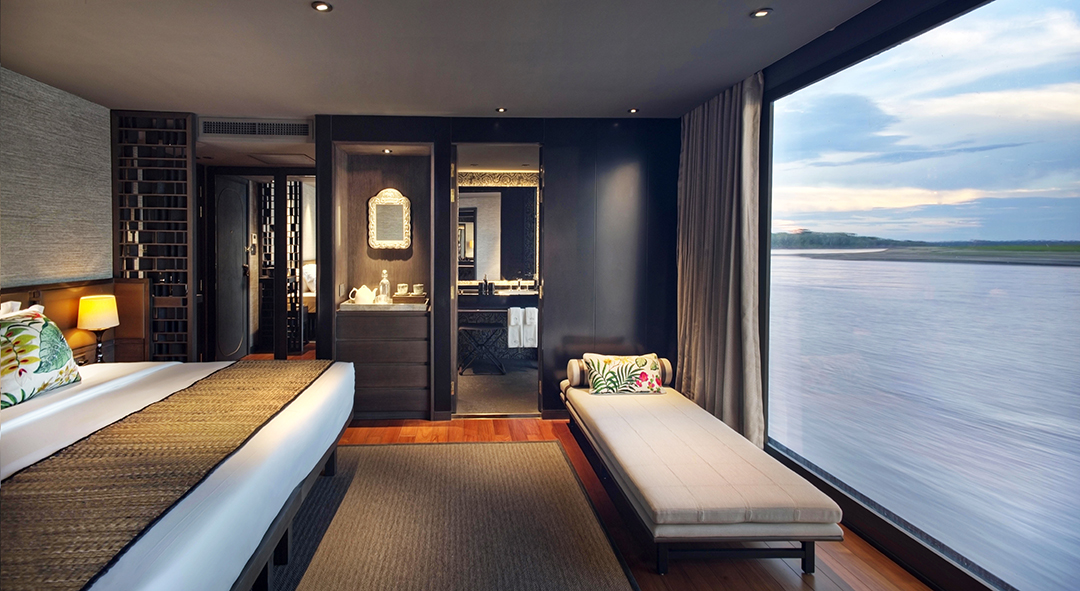
By comparison, it is a hushed affair on Aqua Nera. It has 20 suites for a maximum of 40 guests — and the same number of crew — and the beds face out towards floor-to-ceiling windows so as to maximize the compelling views from first awakening in the morning until retiring at night for sleep. Equally mesmerizing, from the dining room and the bar lounge area, landscapes floated languidly past through the windows. Though never tiring of these, I needed the visceral reality of alfresco breakfasts on deck to remind me that the views from inside were not AI-generated concoctions.
This was real, I was living it, and never more so than with daily disembarkations onto small, flat-bottomed boats that motored us away in small groups before slowing down to linger by a bankside or slip into a creek. The guides, well-versed in their field, were alert to spotting wildlife that we would have been blithely blind to. These daily explorations suspended time and held us captive; moments of pure silence interrupted by gymnastic monkeys, dozing sloths, squawking macaws on a mission overhead or gentle splashes as the heads of pink dolphins emerged from the water for air. Presentations like these, precious and proper mise-en-scènes, became more soothing and therapeutic as they repeated themselves — as if there was more coherence than chaos in nature. The birdlife was unceasingly dazzling, from extrovertly coloured toucans to serenely-hued capped herons, and it came to justify my carting around in my luggage a copy of the weighty Birds of Peru (Helm Field Guides).
A trip at night, drifting under a dense canopy of tropical vegetation and with clouds obscuring the moonlight, was eerily exciting as I witnessed the….
By Sean Sheehan
EXCERPT ONLY. CLICK TO READ THE FULL ARTICLE.
This is an excerpt from the latest issue of Porthole Cruise and Travel Magazine. To continue reading, click above for a digital or print subscription.