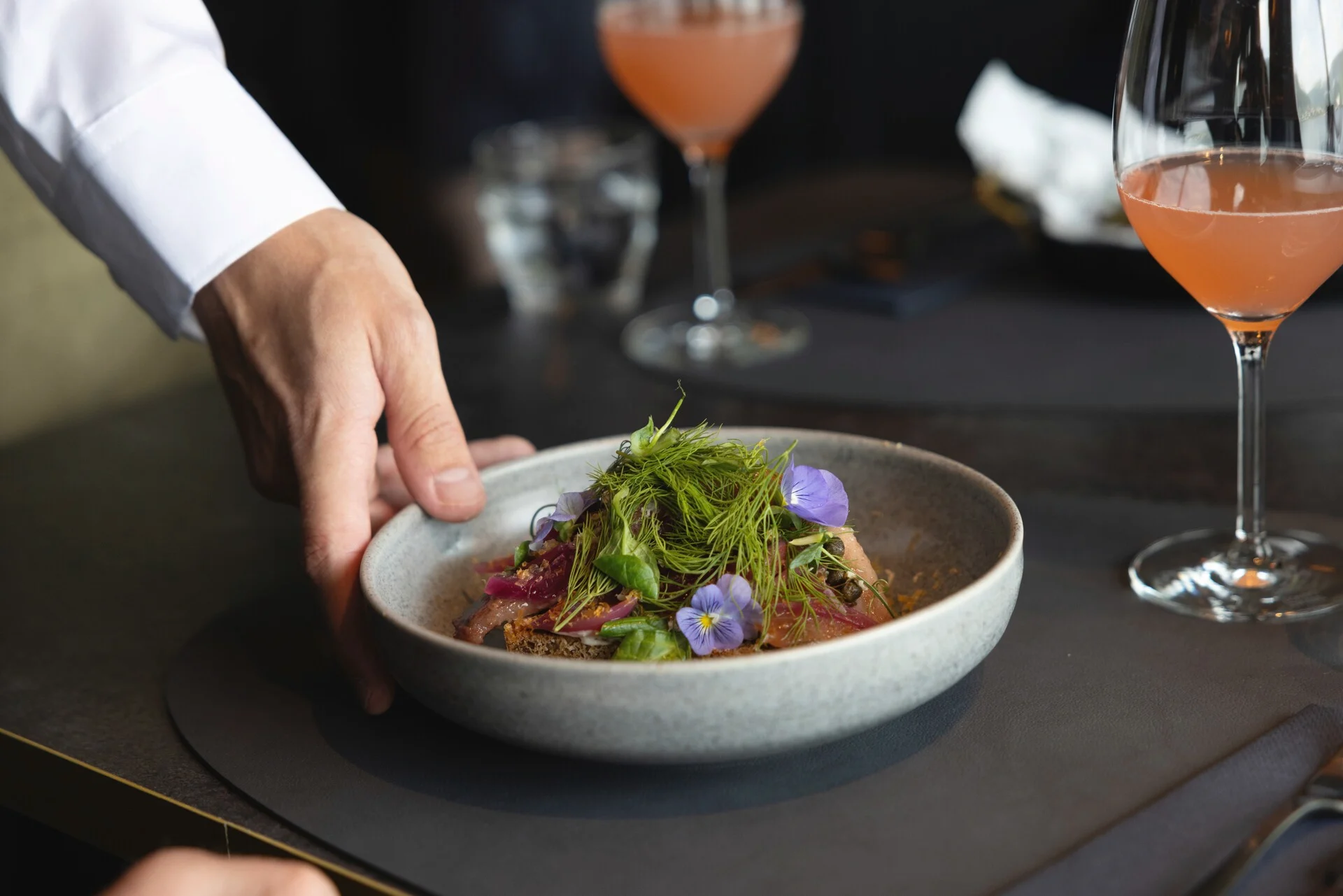
Darkness had long descended. I was high above the Arctic circle, gliding somewhere off the coast of Norway mid-November as I sailed on Hurtigruten’s The North Cape Line, and excited to tuck in to a rich plate of guoppargáhkut, or mushroom cakes.
An autumnal staple in the diet of Norway’s famous reindeer, mushrooms are something the country’s indigenous Sámi people tend to leave to the animals. But some varieties, like chanterelles, freeze early and remain untouched, making them a perfectly sustainable (and delicious) ingredient for humans. Paired with crispy breadcrumbs and lingonberry chutney, the dish exploded on my tongue, offering a bright tang and a uniquely immersive sense of place.
It was part of Hurtigruten’s Sámi Dinner, a menu entirely dedicated to celebrating Norway’s native culture and sustainable values, and partly the brainchild of Máret Rávdná Buljo, the cruise line’s Sámi culinary ambassador. In addition to the food itself, Rávdná Buljo paired rich flavors with detailed descriptions to show passengers not just what we were eating, but why.
“I want [travelers] to learn more about Norway as also a Sámi country… I’m also doing this to lift up Sámi people to give more value to our food,” she tells Porthole, adding that even the language used on the menu was intentional. “That’s very important, to put the Sámi name on the dish so our language is more seen.”
It’s not just a few dishes offered on one night as a sort of lip service. The cultural immersion has been a deliberate effort, ingrained across Hurtigruten’s menus. In Brasserie Árran, for example, which is found on Hurtigruten’s Signature Voyage ships, travelers can sample smoked reindeer souvas with thin polarbread and lingonberry aioli, or warm up with bidos soup from Mydland with smoked reindeer meat and marrow. As an “exceptional culinary storyteller and an important source of knowledge and inspiration for Hurtigruten,” according to Øistein Nilsen, the cruise line’s culinary director, it was equally important to bring Rávdná Buljo’s narrative into the ship’s kitchens as it was to offer her food.
Intentionally Authentic
Adapting a traditionally land-based menu into one that could hit the high seas with gusto was another test altogether. Hurtigruten operates a fleet of eight different ships.
“The greatest challenge is scale and determining what is operationally realistic,” Nilsen says. “Menu development therefore requires a careful balance between authenticity, quality, availability and operational feasibility. From the beginning of the development process, we must be very clear about the volumes involved and work closely with the chef and our suppliers to ensure that the ingredients can be sourced consistently.
“The objective is to preserve the.…
EXCERPT ONLY. CLICK TO READ THE FULL ARTICLE.
This is an excerpt from the latest issue of Porthole Cruise and Travel Magazine. To continue reading, click above for a digital or print subscription.