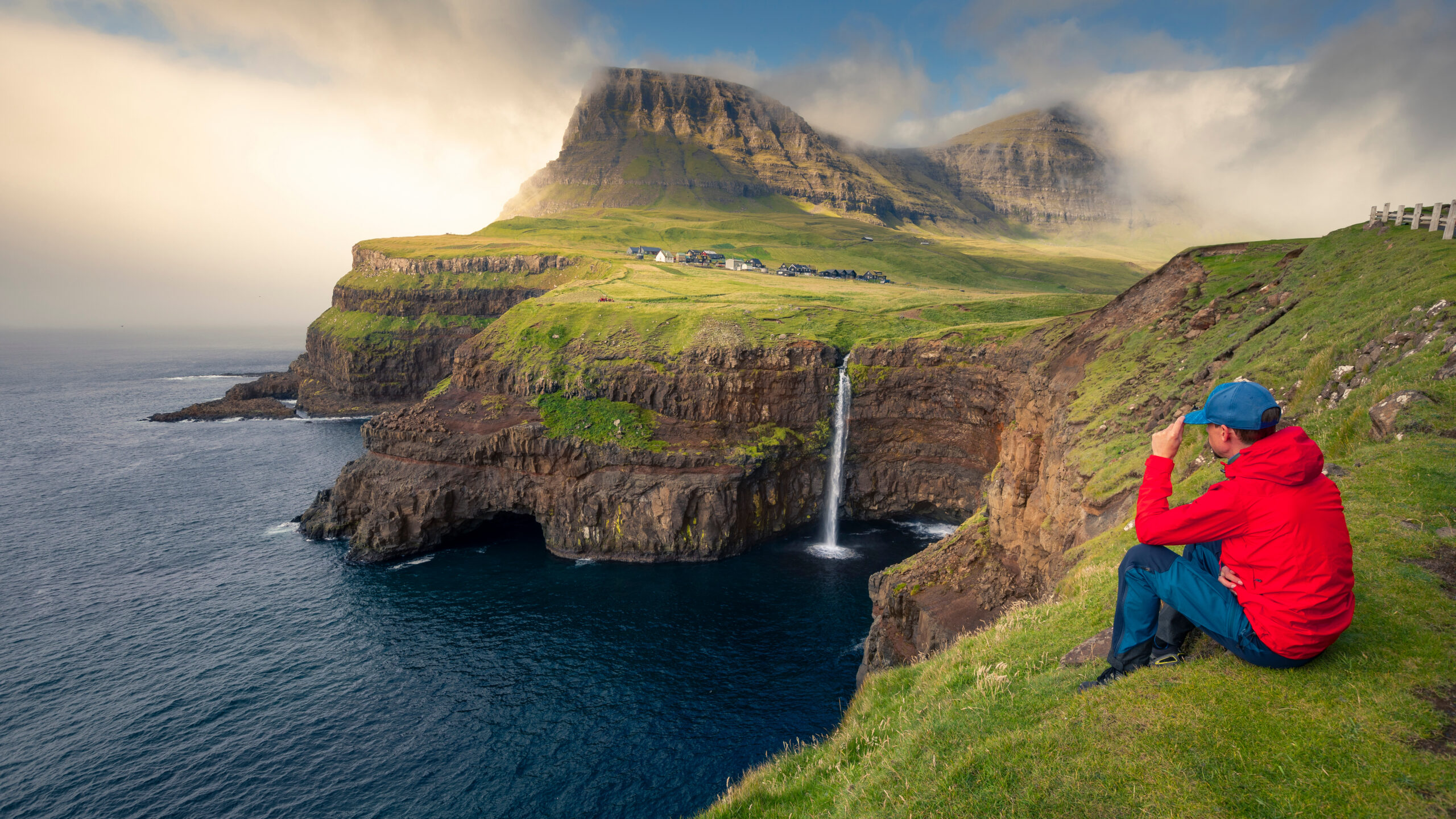
It is just a short 7-mile drive from Vágar airport to the Múlafossur Waterfall near the tiny village of Gásadalur. My journey takes far longer than it should, as I keep pulling over to squeal in delight at the drop-dead gorgeous coastal views. I’ve come to the Faroe Islands on a flying visit to discover more about this picturesque place located in the Atlantic, halfway between Scotland and Iceland.
The ancient Norse name for the Faroe Islands is Føroyar, which translates to the “Sheep Islands.” It is the ideal name for this archipelago of 18 islands, which are home to a large population of wild-haired Faroese sheep. The hardy beasts are perfectly adapted to living in this untamed landscape, where famously, there are more sheep than human inhabitants.
The flock I see contentedly munching close to the Múlafossur Waterfall is completely oblivious to the staggering beauty just a few feet behind them. On stormy days, the cascade defies gravity by swirling upwards. Thankfully, today the sun is shining, and I watch the stream dramatically plummet 100 feet into the turquoise swell below.
Afterwards, I head to Tórshavn, the islands’ capital, where I’m staying at the four-star Hotel Føroyar. The hotel seamlessly blends into the landscape, its uber-cool interior oozing mid-century style, while the grass-turfed roof is a modern nod to traditional architecture. Previous guests include King Frederik and Queen Mary of Denmark, Pamela Anderson, Bill Clinton, and the American rock band Toto. The hotel and spa are situated on the hillside overlooking the city; the panoramic views of the fjord from the hotel’s restaurant provide the perfect accompaniment to a leisurely breakfast.
City Life
Tórshavn, named “Thor’s Harbor” by the Vikings, is the administrative capital of the islands. It’s also where many cruise ships anchor. For more than 1,000 years, the Faroese Parliament has been located on the rocky promontory of Tinganes at the harbor’s entrance. Today, the jumble of turf-topped timber buildings is still in official use. The surrounding area’s narrow, cobbled streets, colorful houses, and chiming church bells all add to Tórshavn’s Old-World charm.
I speak with Elsa Berg, who at 29 is the youngest-ever mayor of the city, about her hometown and the various political challenges she faces. As an environmentalist, she is keen to find a balance between visitor needs and local requirements, but stresses, “Tourists make the capital area vibrant and exciting.”
The Faroese are keen to encourage longer visitor stays and more considered sustainable tourism experiences. The islands have a unique food culture which has evolved due to their isolated location. One local delicacy is fermented wind-dried mutton called skerpikjøt, which is for the gastronomically brave. Other traditional dishes include braised guillemot, preserved puffin and boiled whale blubber, although more straightforward food is also available here.
For a taste of Faroese fine dining in Tórshavn, head to Paz, where acclaimed chef Poul Andrias Ziska offers a two-Michelin-starred immersive experience. Near the harbor, two restaurants — both Michelin-recommended — that explore fresh seafood and traditional fermentation techniques are Roks and Ræst. If you want something more modest, try Katrina Christiansen, which offers Faroese dishes inspired by Spanish tapas. It was previously a general store and is named after a legendary storekeeper. The historic building dates to the 1700s, and its wooden beams and rustic interior make you feel right at home.
Island Country
To discover more about the islands’ rich culture, I head to the Faroe Islands National Museum, where intricately carved medieval pew ends from Saint Olav’s Church in Kirkjubøur, and historic rowing boats catch my eye.
The village of Kirkjubøur is only a 30-minute drive away. You can explore the ruins of the Magnus Cathedral, Saint Olav’s Church, and a Viking-age farmhouse. Alternatively, take the drive of your life along the snaking road to Syðradalur, or investigate the islands’ industrial heritage at the former whaling station at Áir.
I make my way to the island of Eysturoy to meet Harriet Olafsdóttir, a fifth-generation farmer at her smallholding, Hanusarstova, in the small village of Æðuvík. As it is hard to earn a full-time salary from farming alone, she and her husband offer tourist stays, farm tours and traditional home-dining experiences.
The Faroese have a saying: “If there is room in the heart, there is room in the home.” This phrase perfectly describes Harriet’s….
By Cat Thomson
EXCERPT ONLY. CLICK TO READ THE FULL ARTICLE
This is an excerpt from the latest issue of Porthole Cruise and Travel Magazine. To continue reading, click above for a digital or print subscription.