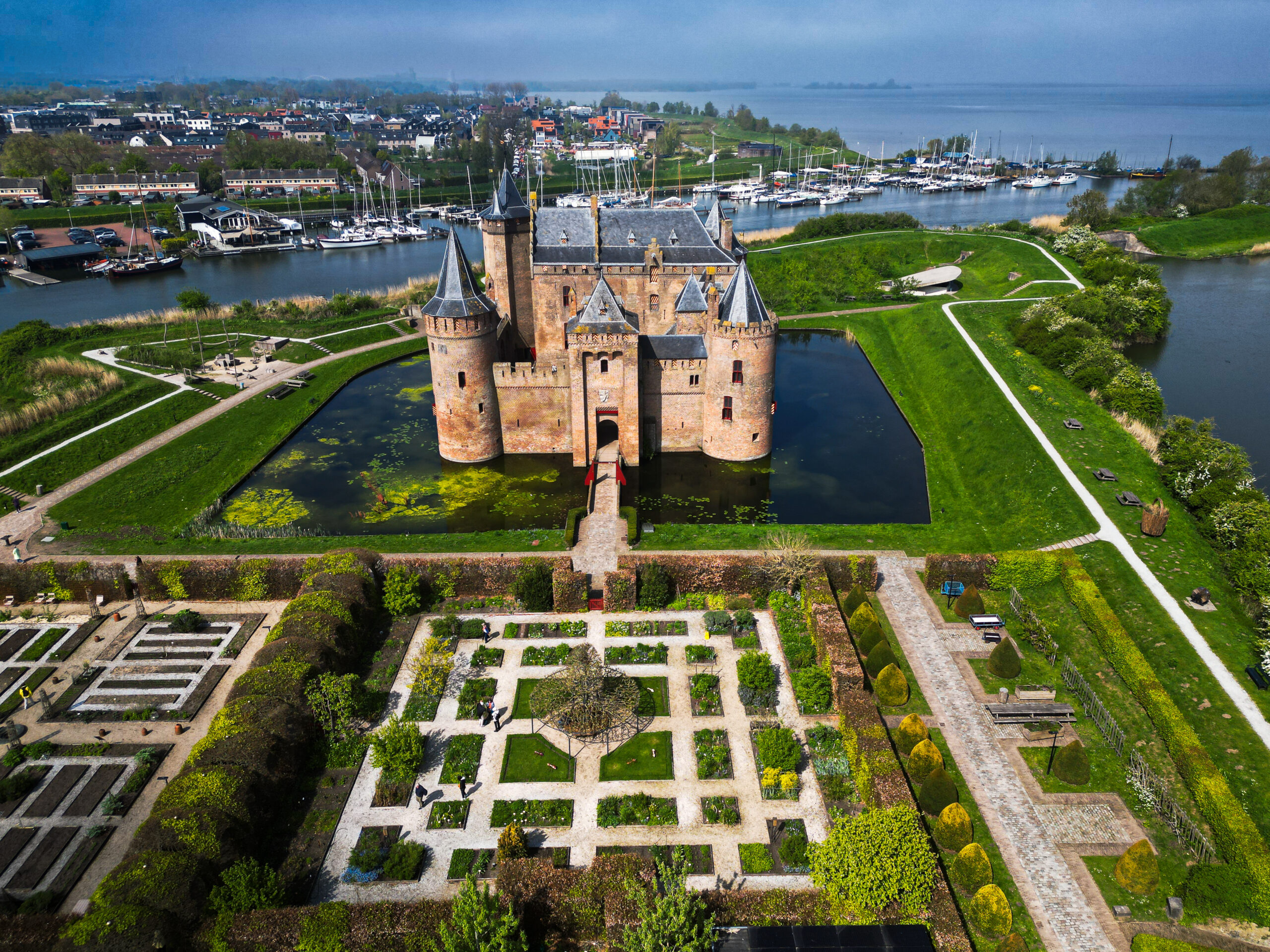
When you think of castles, France, Germany, the U.K., and Ireland may be the first countries that come to mind. Of course they have many, but other countries sit proudly without boasting about their many castles. One such example is the Netherlands. Windmills and waterways may be your primary images of the wet and windy Netherlands; however, many Dutch castles rise picturesquely over a river, lake, or canal.
Touring the Towers
Set in a small village about an hour via public transportation from Amsterdam, Muiderslot (slot is Dutch for “castle”) competes with De Haar Castle as Netherland’s most-visited castle. Muiderslot’s location was chosen by its founder, Count Floris V, at the mouth of the Vecht River so it could function as a toll booth. From Muiderslot’s founding in 1280, vessels sailing to and from the independent state of Utrecht could only use this important trade route to the sea by passing this castle and paying the toll.
Muiderslot and Floris’ other toll schemes significantly impacted the founding of Amsterdam as a city. Today, easy access from Amsterdam Centraal makes this a perfect castle to visit before or after a cruise. Cruisers based here may find the Amsterdam & Region Travel ticket convenient for visiting Muiderslot and other nearby attractions.
Even more castles are more quickly and efficiently reached by car. Muiderslot is quite an authentic, well-preserved castle with all the elements expected of a castle. Other castles have been repurposed as event venues, hotels, or private residences, or have been rebuilt multiple times over former ruins, losing their original character. Many castles, including Muiderslot, have cafés, events for kids, like dressing in period costumes, scavenger hunts and other interactive displays. If you choose not to cosplay a knight or a soldier, forget the chainmail and helmet and stroll through the multiple exhibits instead.
Some of the Netherlands castles are quite close to each other and make combining a visit quite practical, but do be aware that none were built with accessibility in mind; in fact, quite the opposite. Some have limited areas for those with mobility needs, while a few may include elevators, sometimes hidden from view and only found with the help of a guide.
Waterfront Properties
Water played an important part of castle defense being readily available for moats, and the surrounding water provided easy access for trading, critical for toll collectors who accumulated massive wealth and power. Although many castles never saw battles, the defense features of the castles exhibited strength and power to the surrounding residents.
Because of the landscape of the Netherlands, castles are mostly on flat ground rather than perched on higher spots like those along the Rhine. Waterfront locations allow for both Muiderslot and nearby Loevestein Castle to be visited by boat or ferry as well as by the A2 highway.
Loevestein Castle, located at the confluence of the Maas and Waal rivers, controlled river travel and was involved in a few battles, but it is mostly known for its function as a prison. It was involved in the Franco-Dutch War along with Valkenburg Castle, a two-hour drive south, which saw many battles. Valkenburg was besieged many times and rebuilt many times, but is now scenic ruins. It contrasts with other castles in the Netherlands as it was built on a natural hill in the Limburg area near Maastricht, the only part of the Netherlands with hilly terrain.
Most castles stand with massive, manicured gardens; Muiderslot and De Haar Castle are fine examples of castles with magnificent gardens that are….
By Theresa Russell
EXCERPT ONLY. CLICK TO READ THE FULL ARTICLE.
This is an excerpt from the latest issue of Porthole Cruise and Travel Magazine. To continue reading, click above for a digital or print subscription.